Pro Contractor Studio Knowledge Base
Accent Lighting Wire/Cable
Menu: |
Lighting
|
Toolbar Icon: |
|
 Wire/Cable
The Accent Lighting Wire/Cable command allows you to draw wire or cable from a lighting transformer to the lighting fixtures. You can change the label indicating the wire size on the design screen and the color of the wire.
To start adding wire/cable to the drawing screen:
Click on a wire selection one time with the left mouse button. You can add, delete or rename the wire selections.
Under the Wire Settings header, enter a label to indicate the size of the wire on the design screen in the Label text box. Examples of wire size labels are 14, 14 Ga., 14 Gauge.
To assign a color to the selected wire size, click on the Color button. Click on the color of your choice or enter the Red, Green, and Blue values in the associated text boxes. Click on the OK button to accept the color assignment.
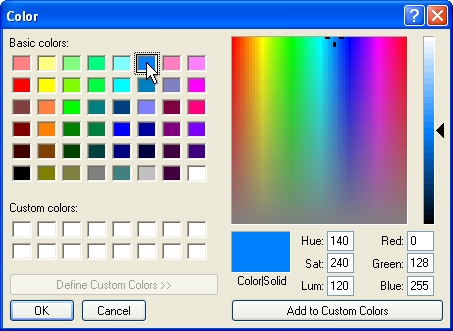
Select a color assignment and click on the OK button.Enter the resistance in Ohms per 1,000 feet in the Resistance text box. Even if you are designing using Metric units of measurement, enter the Ohms per 1,000 feet.
Enable the Show Wire Label check box by clicking on the selection with the left mouse button until a checkmark appears in the box to show the wire label on the drawing screen. If this feature is disabled, the wire label will not appear on the screen. If the Show Wire Label check box is disabled in the Layer Manager, the labels will not appear on the design screen.
To begin drawing wire on the design, click on the Draw Wire button.
Set two or more points to draw a piece of wire. You may press the Esc key to "backup" and remove points set while drawing wire. Press the Enter key to end a piece of wire. Continue placing additional wire as necessary.
If wire from one circuit crosses wire from another circuit, you must insert a wire hop to prevent the software from combining the two circuits during lighting calculations.Press the Esc key to end the command and return to the Wire/Cable Placement dialog box.
Click on the Close button to exit the dialog box.
Note:
You can drag the mouse cursor close to a lighting symbol and press the right mouse button to "snap" onto the symbol. This is the best method to insure the wire is connected to the lighting symbol.
When drawing wire or cable, the wire must start or stop within the set Wire Connection Distance from the insertion point of the lighting symbol. The Wire Connection Distance is set in the Lighting Options command. The default setting is 3 inches (0.25 feet). Depending on the chosen symbol, the insertion point may be in the middle of the symbol or some other location. Note the point from which the symbol rotates as you place it on the drawing screen. The base point of rotation is the insertion point where the wire must stop or start for voltage drop calculations to function.
The only exception to this rule is at the transformer location. Wire from two or more circuits can meet within the connection distance at the insertion point of the transformer symbol. The software will ignore the connection distance at the transformer.You can override the wire size label location on the design screen using the Properties command. Select a piece of wire and click on the Override Label Point checkbox. The wire size label will attach to the mouse cursor. You can then place the label in a new location by clicking on the design screen with the left mouse button. To return the label to its original position, un-check the Override Label Point checkbox.
Set the cost associated with each piece of equipment, the part number and the tied assembly assignment in the Equipment Costs command.
You can change the line type, width and scale of the Lighting Wire layer in the Layer Manager.
If the Show Wire Labels checkbox is disabled in the Layer Manager, the wire labels will not appear on the drawing screen.
You can use the Select Layer button in the Layer Manager in conjunction with the Move to Back command to move the wire underneath other accent lighting symbols.